Fourth Men
Last and First MenThe Fourth Men are a species of artificial, largely stationary intellectuals whose vast, engineered brains make them the dominant researchers of their age. Their civilization joins living tissue to elaborate machinery, and their rule over the Third Men rests on the prestige of their knowledge. Yet the same specialization that lets them pursue inquiry across the planet leaves them deficient in bodily and emotional breadth; when they recognize that knowledge alone cannot answer the questions that matter most, they set about creating a more complete successor species.
Artificial Origins and Design
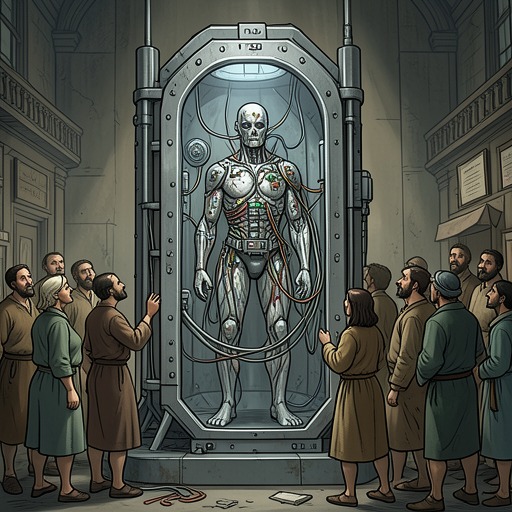
The Fourth Men emerged from a long sequence of experiments in artificial human life. An earlier child survived for four years before pain, mental disturbance, and failures of bodily regulation led to his death. After centuries of unsuccessful attempts to improve on that experiment, the first true individual of the Fourth Men was created with more efficient mechanical and chemical systems. His makers expected that careful management of growth and decay might make him immortal.
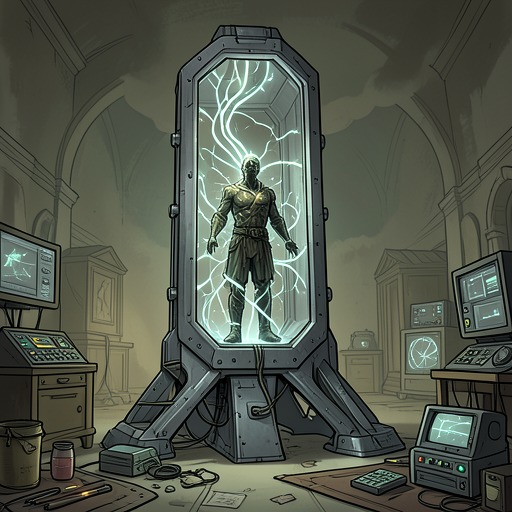
The defining innovation was his brain’s architecture. Instead of developing as ordinary convoluted hemispheres, the growing brain cells were guided into compartments within a circular turret, about forty feet in diameter. The structure’s central space opened onto radiating passages and tiers of small compartments; tubes carried blood and chemicals, while electric radiators maintained warmth. Gauges and indicators allowed attendants to monitor the hybrid system. The brain was not simply housed in a machine: its development had been shaped around an engineered environment, making the individual a joined biological and technical construction.
His development was exceptionally slow. Eight years after the organism began, its brain had filled the turret and its mentality had reached that of a newborn. It was not until nearly the end of his fifth decade that he approached the mental level of a bright adolescent. In the decade that followed, he learned what the Third Men could teach him and recognized that much of their wisdom was mistaken. His hands were dexterous, but he chiefly used them to serve an intense curiosity. Inquiry, rather than companionship or ordinary social attachment, would define the purpose of the species he founded.
A Distributed Research Civilization
About three thousand years after his own beginning, the first individual determined to create others of his kind. He did not act from loneliness or a desire for affection: more profound research required collaborators of comparable mental stature. Factories modeled on his own, though improved, were established in different parts of the planet, and cells from his vestigial body were cultivated to produce new individuals. He also underwent extensive reconstruction, enlarging the plan of his own capacities.
The resulting population numbered about ten thousand. Its members were adapted to the places and work assigned to them. Some occupied high mountains, where they studied the heavens from vast observatories; others, suited to heat, investigated forces beneath the planet’s surface. Fourth Men pursued research in the tropics, the Arctic, forests, deserts, and on the ocean floor. Their brains incorporated specially bred Martian parasites, giving them direct sensitivity to radiation, and each possessed powerful wireless equipment. These provisions enabled telepathic contact across their widely separated, stationary communities.
The Third Men who had helped produce the new species became the laboring population of its civilization. They cultivated land, tended cattle, and manufactured the material resources the Fourth Men required, while their inherited vital art settled into increasingly stereotyped ritual. This subordination developed gradually, but it became a source of resentment. Rebellions flared occasionally and failed to become serious upheavals, in part because the Fourth Men’s prestige and powers of persuasion remained formidable.
The Limits of Knowledge
For roughly three thousand years, the Fourth Men’s research advanced with sustained success. Eventually, however, progress slowed. They could continue to fill in details about their planet and the stars, but they saw no clear route to entirely new fields of inquiry that might reveal the essential nature of things. Their knowledge was systematic, yet its meaning remained obscure: the more completely they organized what they knew, the more sharply they felt how little they understood.
Their diagnosis reached beyond the limits of intellect. They came to see that their greater failure lay in their restricted insight into values, a weakness produced not by too little brain but by too little body and lower-brain tissue. They could not correct that defect by remaking themselves without ceasing to be what they were. Their distinction as thinkers had not made them comprehensive beings; the capacities that served knowledge had left other forms of understanding underdeveloped.
Creating Their Successors
The Fourth Men considered producing a more harmonious kind of being and concluded that the work could fulfill their own purpose even if they could not personally attain its goal. Full knowledge, they reasoned, required minds more penetrating and more broadly based than theirs. They therefore redirected their abilities toward producing beings free of their limitations, in whom they might reach that goal indirectly. For the Fourth Men, creating successors was not a retreat from research but its most demanding new undertaking.
They began work on surviving specimens of the Third Men to produce their own replacements. The shift marks the central reversal in the Fourth Men’s history: the species that had organized the world around its investigations recognized that its own form could not encompass the knowledge it sought. Its greatest project would thus preserve its intellectual ambition by passing it to a successor, even as that project placed the Fourth Men themselves on the path to being superseded.